


Teaser: Infrastructure investments might be challenged in many countries, as the fiscal firepower will most likely be used towards rescuing the economy, though the winning governments and countries will continue investments in digital infrastructure.
Since the start of this year, Facebook’s stock price is up with 15 pct. and the Alphabet Inc./Google has gained 10 pct. during the same period. This performance is representative for many listed companies in the technology sector around the world. I mainly regard this development during the Covid-19 outbreak as a market reaction on the winning and losing companies, as a consequence of the virus. The stories about the deeply hit airline industry are well-known, and during the crisis, social medias and other technology platforms have been the winners, thus the rising stock prices.
But for many user-driven technology companies like social medias, it’s definitely not enough to fuel future growth if more people spend more time on their platforms during a lockdown period. The growth in the business case for the rest of this decade is heavily dependent on a continued huge surge in the number of internet users around the globe. The same remains the case for the GDP growth in many countries, though this whole technology mega trend could be threatened by Covid-19.
Since long, one of the megatrends that we have strong focus on in my company is very precisely, the global number of internet users. That particular number includes mutual different developments where the global broadening of the internet is obvious, though behind that evolution, one will find the private and public investments in technology/digital infrastructure. This is the reason why I pay attention to the worldwide number of internet users. In our global conviction model, it’s a megatrend because it remains a gamechanger, even for countries, and I expect it to be the case for the rest of this decade.
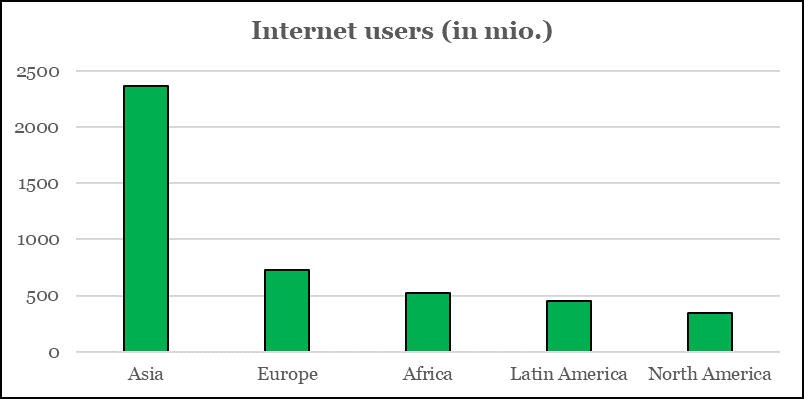
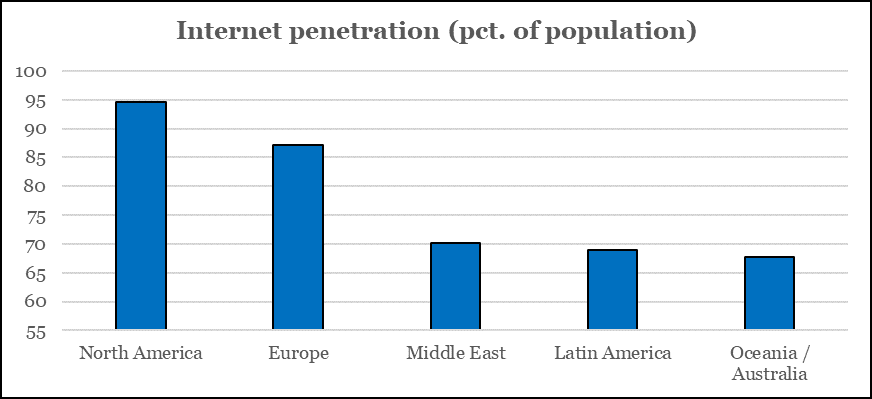
In 2018, the worldwide number of internet users was around 3 billion people. Based on different forecasts, the world should currently explore an almost exponential development in the number of users rising to 4.4 billion last year and going further up to 6 billion people in 2022. This is a 100 pct. increase in just five years, though towards 2030, the growth is levelling out where the expected number of internet users is 7.5 billion people. If one combines the two graphics, the overwhelming Asian dominance in the number of internet users is obvious and the continued growth remains in Asia and in Africa. But circling back to a very concrete example, at the same time in 2030, Facebook is expected to have 5 billion users– a private company that was founded in 2004.
But the growth in the number of internet users naturally requires ongoing investments in digital infrastructure. Technology/digital infrastructure investments is a part of the overall infrastructure investments, which very often requires some sort of government or public involvement.
It’s the Covid-19 outbreak that can threaten the described tech megatrend, as the involvement also means money from the fiscal budget. Currently, some countries are still deeply involved in the Covid-19 battle, whereas other countries are moving away from the virus grid and heading in the discussions about how to get the economy back on track.
Even in Western countries, I have noticed the sweetness by suggesting an increase in the classical infrastructure investments such as building more roads, railways and bridges. It’s an easy sell to voters, as everybody visualises the jobs these investments create and at the same time, hope that it will reduce the traffic jam and move goods faster.
It’s so much more difficult to convince voters about the value of digital infrastructure investments. The job creation and the economic growth it generates is different and might have more importance on an individual level and for SME companies. But if digital infrastructure investments are chosen well-considerably, then it will truly support economic growth. This applies particularly to Emerging Market economies and for so-called advanced economies.
In the coming months, I expect that many countries will explore a growing discussion about how to spend the money on the fiscal budgets, which will range from supporting private households and corporations, to the full spectrum of which infrastructure investments to prefer.
The needed investments are huge, where recent projections from the ADB showed that the Asian need for infrastructure investments are at 1.7 trillion US dollars per year, until 2030, to ensure the GDP growth level as before the Covid-19 crisis.
It’s a huge amount and it gives an impression about how public budgets will be stretched after the crisis. I pay close attention to which countries and governments have enough foresight to upgrade the digital infrastructure investments, as this will support how attractive a country is, as an investment destination.
Ironically, the Covid-19 crisis itself might support the favour of digital infrastructure investments. Not only Facebook and Alphabet Inc./Google fared well during the crisis, but so did digital infrastructure investments. The new trend with “working from home” is on a global rise and I judge that it will require a significant upgrade of the internet coverage and connection, especially in the countries that are big in outsourcing and call-centre activities.