


Teaser: The EU has agreed about a giant economic rescue package, though The European Central Bank already used its monetary firepower.
On Tuesday, the 21st July, all EU countries have finally agreed on the historically large EUR 750-Billion economic rescue package. For the Eurozone countries, The European Central Bank (ECB) has already made some supporting moves on the 18th March and the 4th June by announcing further, and heavy, bond purchasing.
In my view, the further ECB purchase of Eurozone government bonds, which the individual member states can again convert into domestic economic Covid-19 crisis support, is the only dry gunpowder that the ECB has left to mitigate the unexpected economic crisis.
Inflation in the Eurozone has fluctuated around two pct. for several years now, therefore, I have since years argued that the ECB should have raised the interest rate to more than two pct. Now, I argue that the European Central Bank has instead wasted an opportunity when dealing with the economic crisis that has developed in connection with Covid-19.
The reason for my position is that I regard the ECB’s monetary policy, with an interest rate significantly lower than the inflation, as an intervention. It is even a monetary policy intervention of the more unusual kind, but nonetheless that is how I perceive it. Thus, this also provides the explanation as to why the action is not succeeding, as a solution to the Eurozone’s economic problems, following the global financial crisis ten years ago.
Concerning the newly agreed EU rescue package, Italy has positioned itself as one of the most economically hurt countries in the EU as a result of the Covid-19 crisis, and is therefore foreseen to receive the most from the historically large rescue fund. Italy taking the hardest hit was also the case after the global financial crisis, as well as in the first half of the 1990s, when the European currency stability system (ERM) collapsed. Therefore, the country’s economy is unfortunately also a shining example to bring forward in this context.
Graphic one shows the Italian state’s interest expenditure as a percentage of the government’s revenue (calculated according to the World Bank’s methodology). One can observe how the country has been able to refinance itself cheaper after joining the euro, but after the global financial crisis, the picture turned for a few years. This was because the ECB did not adopt the quantitative monetary policy as quickly as, for example, in the United States, thus raising doubts about Italy’s future creditworthiness.
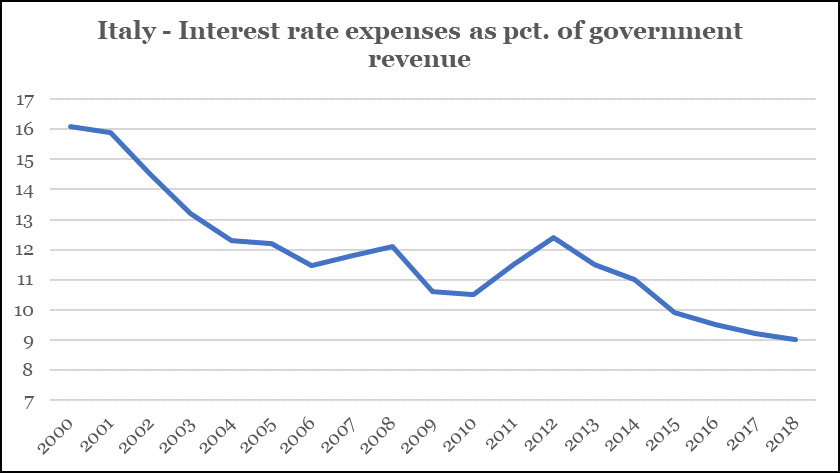
As the ECB decided to fight the economic pain following the global financial crisis, the ECB chose to make a double monetary intervention of almost unprecedented historical calibre, which led the public Italian interest payments to be reduced further. The ECB introduced the quantitative monetary policy in the form of buybacks/interventions in the bond markets. In addition, the central bank lowered its key interest rate so sharply, that there have been negative real interest rates in the Eurozone for a number of years. In my view, this is a very powerful intervention which a central bank can only maintain for a relatively short period of time and which only works under very specific conditions.
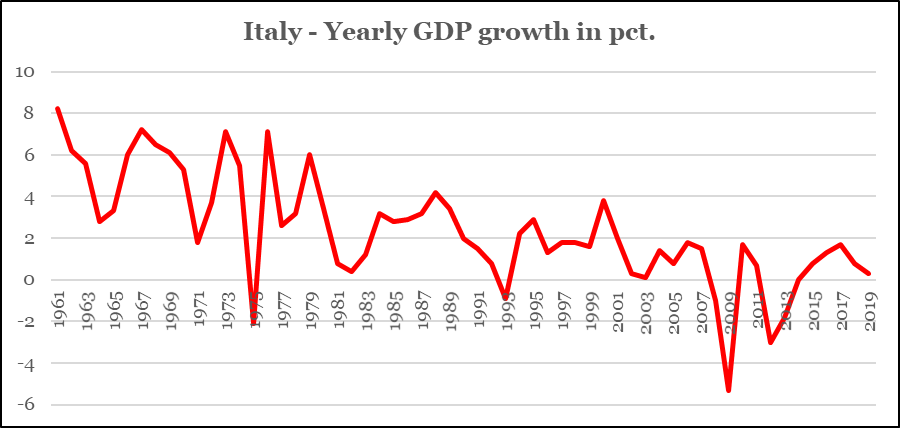
Provoking negative real interest rates is more dangerous than playing with fire, as it leads to too high indebtedness that can result in a poor solvency that can be dangerous when a crisis sets in, such as now.
Almost even worse is the wrongfooted timing by introducing the extremely low-key interest rate. The global financial crisis was also a debt crisis where a number of countries have become too heavily indebted. The global financial crisis, which raged ten years ago, was fierce for several reasons, but it was a classic economic crisis where the only real official answer is reforms and changes. Neither Italy, nor most of the other countries in the Eurozone managed to implement the necessary reforms before the next crisis was able to set in, which is right now- a full decade later.
The Covid-19 economic crisis is a completely different crisis compared to the global financial crisis. In the current crisis, it is unlikely that an extreme monetary intervention could have a positive effect, as the cause is simply the nature of the crisis. The virus itself naturally affects the economies negatively. In addition, precautions, lockdowns, etc. have a high price. However, the most likely scenario is that the virus will come under control, which means that economies and countries have the opportunity to get back on track differently, compared to a classical economic crisis. This current crisis expresses a different temporary negative effect, where it makes sense to have economic government support and maximum monetary policy support from the central banks.
I belong to the minority who argue that the extremely low interest rates conducted by the ECB during the recent years has largely been worthless. On the contrary, my view is that now, it would really have helped if the ECB have had the opportunity to lower the interest rate from, for example, 2.50 pct. to zero pct. while the Covid-19 crisis is hunting the economies. In such a situation, the central bank could have communicated well that the interest rate cut only is for a relatively short period of, say 12 to 18 months. It would be a temporary intervention with effect, but the ECB has, in my opinion, played out its trumps during the last ten years. The central bank claims to have plenty of dry gunpowder left, which is possible, but my view is that the powder seems moist. My take is that the Eurozone does not necessarily have a strong central bank at the moment, which is a factor when investors consider the global allocation of the investment portfolio.