

Teaser: The fear level in the global financial markets is rising, though without “just” foundation.
Certainly, the American central bank’s (Fed) sharp change in its direction for the monetary policy has also changed my assessment of several developments in the financial markets this year, but I don’t fear the future as much as the financial markets increasingly do.
I regard the decision to stop the interest rate hikes as the important change. The big change is not the revised growth expectation where Fed now expects the American GDP growth of 2.1 pct. this year versus 2.3 pct. in the prior forecast from the start of the year. Quite right, it is relatively quick that Fed has lowered its estimate again, which clearly states that the headwind for the US economy is bigger than previously expected.
I respect that the rapid downward adjustment in the growth estimate can indicate an increased risk of growth expectations being downward-revised again. It leads to some corrections, for example, the equity markets, and is reasonable. But the increasing fear that the financial markets have shown recently makes me think about the good old saying, that “the only thing I fear is the fear”.
What do I mean by that? I argue that the expectation on the US GDP growth is lowered from just over two pct. to just below two pct. plays a minor role. In August and September last year, the big topic was whether the US economy would enter a recession this year or next year. Although the International Monetary Fund (IMF) has also recently lowered their US growth expectations for 2019, the respectable organisation actually argues for a slightly higher US growth next year. This outlook should be far from enough to create fear in the US stock market, but it is here right now- the fear.
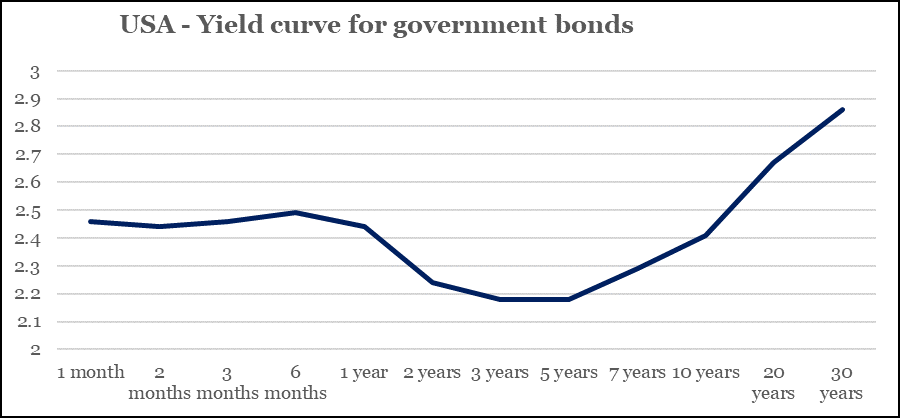
Some support the fear scenario and graphic one shows the currently inverted yield curve for American government debt, in particular five to seven years ahead. It means that the interest rate on a bond with a longer maturity is lower than the interest rate on bonds with a shorter maturity. This can happen if, for example, investors expect a falling inflation. Lower inflation might express the expectation of a lower economic activity in the future. And as many argue, when the yield curve has historically inversed, it has been followed by an economic recession in the US.
In my opinion, there is a bigger force behind the inversed yield curve that the significant change in Fed’s monetary policy also took the fixed-income market by surprise, and therefore, investors moved further out of the yield curve. Now, there is suddenly no prospect of falling bond prices after Fed cancelled further rate hikes, and if inflation is also slowing down, then there is good reason to buy bonds with longer maturities.
I thereby quite clearly argue that I do not regard the inversed yield curve as a warning signal of a coming recession in US. In my most likely scenario, it seems too far away from the actual risk when considering the current growth and the decent outlook for the expected growth.
Right now, I mostly fear the tendency of a negative momentum in the stock markets. It’s another expression of fear where my feeling is that a growing number of investors are afraid of not selling-out before their neighbours do. Though I regard the fear as already diffused, because last year, the companies’ earnings began to dive, which of course, must be corrected in the stock price, and has already happened.
How much investors expect to get in return from the US stock market during the next few years is a good question, but my expectation is about five pct. in the next 10 years ahead. I do not know how many other people share this humbler return expectation, but I am not alone, thus some lower expectations are already priced-in the market. Moreover, many stock markets did correct lower last year, and should not spill over in more selling, so I lean towards the contrary.
The developments that I argue one should fear are not new either, but in the current situation, all negative news and developments naturally contribute to the fear scenario. A worrying development remains due to the poor political work and leadership in a growing number of countries. United Kingdom is t currently the prime example, but in general, Europe is outspokenly characterized by a lack of economic reform initiatives.
In my view, this contributes to what really should be feared, which is the sharp drop in economic growth that Europe currently is experiencing. I expect the current downturn as a move towards a coming decade to a Japanese situation, with close to a long-time zero-growth economic environment.
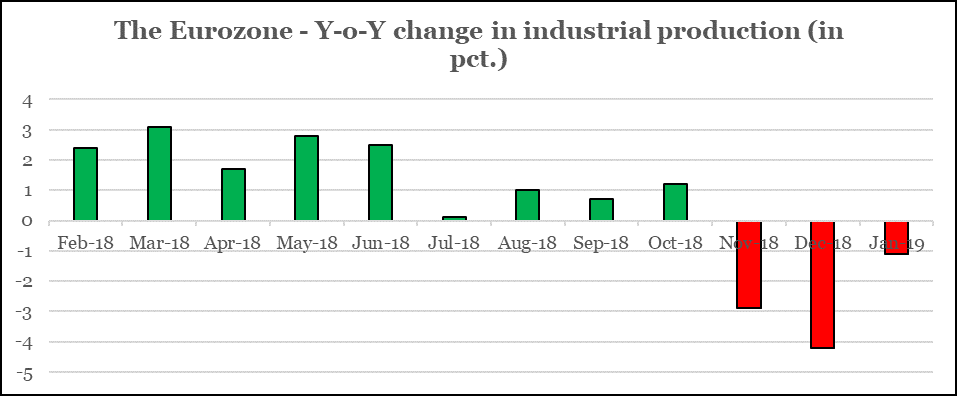
Graphic two clearly shows the decline in the Eurozone’s industrial production, though the comfort is that January was not as negative as expected. In my opinion, the overall and long-term economic development in Europe is to be feared, as the Fed also points out. Conversely, I do not regard this is as something new, but it will remain a reason as to why investors are looking elsewhere and away from Europe.
The European negative development has been underway for a long time, but elsewhere in the world, I regard economic growth as fairly robust. This robust view also includes the United States, albeit at a lower level than in the past few years.
It should not be underestimated that in these years, the stress on global growth is rising during for example, Trump’s trade wars, the Brexit, etc. I consider this to be pretty stressful for the global economy, but despite these stress factors, growth remains robust in many regions outside Europe– if the global economy was truly vulnerable, it would have long entered into a negative spiral, given the stress.
Concerning the global economy, I have never been super-optimistic either since the global financial crisis. Though, I do not consider the current rising fear as justified by many or heavy rational arguments.
However, I am of course, aware of the immediate momentum in the financial markets, and that leads back to the fact that the only thing I fear is the fear- I argue that the Fed has pushed the financial markets towards more fear than necessary, as the central bank could have calmly continued to hike interest rates without creating fear.