


Teaser: Like the production of goods, the monetary policy has also been globalised over the past 30 years, but the monetary policy environment is now changing – it probably reverses and will soon reveal stress in some economies.
In the 1980’s, China slowly opened its economy, and soon became an outsourcing destination for the production of goods. The globalisation developed further after the Cold War ended in the early 1990’s, where all the former Central and Eastern European countries suddenly joined the global production platform. In my view, the two steps represented major movements in globalisation, and the third level of globalisation has been a digital-based jump over the past 10 years.
During the past 30 years, a monetary globalisation has also been taking place, which on the contrary is pretty easy to reverse.
During the 90’s, a development happened when global trade, as a part of the production globalisation, took-off. The first step was simply to open up for more cross-border capital flows, though that alone requires some fiscal discipline for countries, in order to avoid capital flight and currency crises.
The second big jump in monetary globalisation was after the financial crisis almost 10 years ago, when the large central banks introduced “quantitative easing”.
The financial crisis was simply an expression for an economy facing an unhealthy situation. The correct solution would have been to let bankruptcies correct the economies. It would, without any doubt, have generated a revamp, and brought the production globalisation into a brand new third stage. Further, many countries would have been forced to introduce significant economic reforms
This didn’t happen (particularly in Europe), but was counteracted by the quantitative monetary policy as the next step in the monetary globalisation.
But at least the American quantitative easing is coming to an end, i.e. the global monetary policy is starting to reverse. It can hurt many countries that didn’t conduct the necessary economic reforms during the interim period with abundant liquidity. In the future, I therefore expect investors to be much more selective when choosing their preferred investments. The result is limited liquidity for a number of countries, which will disclose a weak position for these countries – the coming macroeconomic B countries.
Macroeconomic A countries are those who are fit in one or more ways where I pay attention to the following strengths: Strong private sector growth or strong private domestic demand, a strong fiscal position, a monetary policy that isn’t dependent on cheap money from the global monetary quantitative easing, surplus on external balances (like the trade balance) or well positioned in the global production or service competition.
A distinct development that I expect is even greater focus on domestic economic growth in all countries, which will require some of the above mentioned macroeconomic strengths. Some growth initiatives could well be classical public investments in infrastructure, which is not necessarily healthy. Surely, increased public spending will be directed towards health care, plus increased transfers of government money to retired people. This indicates that export will lose in terms of importance, and therefore investors are forced to invest into domestic growth – preferably in the A countries.
I argue that there are A countries among both the old economies and Emerging Market economies where the decisive parameter is the number of forces, as prior mentioned. That monetary policy is likely to tighten globally and will hit countries that have benefited from cheap liquidity without reforming their economies, such as Italy in Europe.
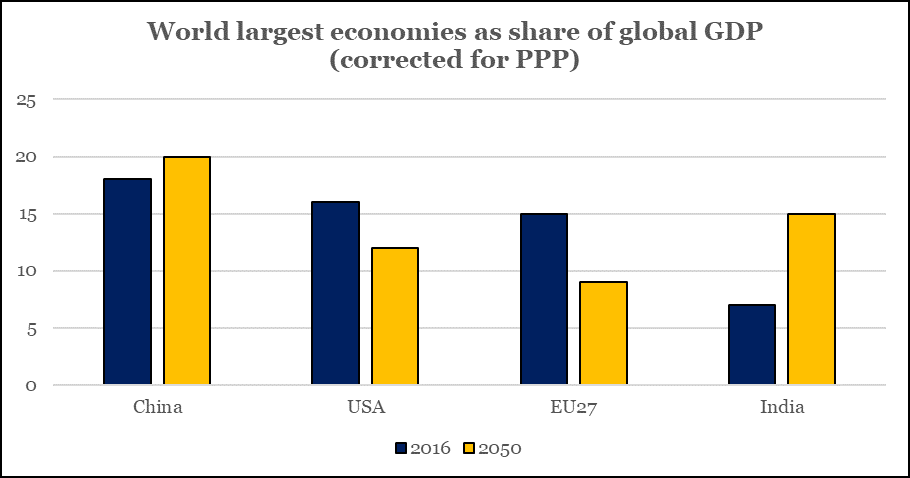
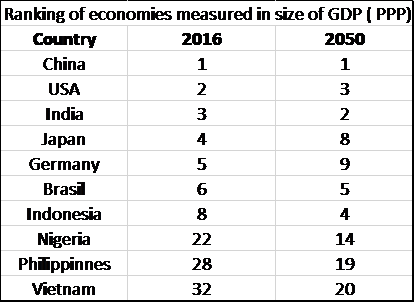
It all underlines how the world is currently being redefined. It’s very well shown by the company PwC in their study “The World in 2050” that I got from a while ago and have been saving for a good day. In the study, PwC uses GDP adjusted to the purchasing power, which reveals the conclusions. But it is not wrong by any chance, as it expresses how the purchasing power and material wealth is experienced in the individual countries.
When comparing GDP adjusted for purchasing power, China is already the world’s largest economy, but it is interesting how the ongoing global economic process revamps the world. The U.S. will maintain a certain position, but for example, the EU really loses significance (EU27 is excluding the U.K.). It won’t take many years before the world economy is dominated by the current Emerging Markets countries. This fits well with another mega-trend that I argue has a great importance to companies and investors. Namely, the 1.5 billion people in Asia who move up into the income middle class over the coming 10 years.
The biggest economy in the world, USA, I regard as an A country, though not particularly strong. Whereas I would rate China as a somewhat stronger macroeconomic A country. Despite the risk of a currency crisis one day, I would surely rate the Philippines as an A country and the same for Indonesia. In Europe, Germany and Switzerland would survive as A-nations and some might be surprised that I consider United Kingdom as a macroeconomic A country, but I do, and I trust they will do heroic work to stay fit.
Macroeconomic B countries will also offer investment opportunities, though the environment for finding investment opportunities in A countries will simply be much better. Further, it will have an important impact for bond investors. How fast this development will progress, I see as a function of how fast the U.S. central bank (Fed) scales back their part of the global monetary policy – though it’s not some day in the future, as it’s already happening now.