



Teaser: Lately, there hasn’t been so much to celebrate in the financial markets, though many would probably also be happy with less – if this wish can be fulfilled.
Around this time each year comes the consideration of whether to sell out of the stock portfolio and return with the buy orders later in the season, or simply keep the investments. The consideration, of course, origins from one of the many good American proverbs found in the financial market, namely; “Sell in May, and stay away”.
In four to five months, we will all know if it would have been best to sell in May or stay positioned. Anyway, it should be said that by a normal long-term investment portfolio, it would be a drastic step to reduce the equity portion to zero. But a tactical change of risk and/or allocations in other directions is always worth a consideration.
In my opinion, there is no doubt that the global economy is still cooling-off. Therefore, I expect an increased risk of rising nervousness in the financial markets around the globe. Graphic one shows a declining German consumer confidence, where the decline now starts to be prolonged. The strength in the negative trend is surprising, and one must consider that Germany has historically low unemployment. This has long been a concern in my assessment, as Germany after all is Europe’s largest economy.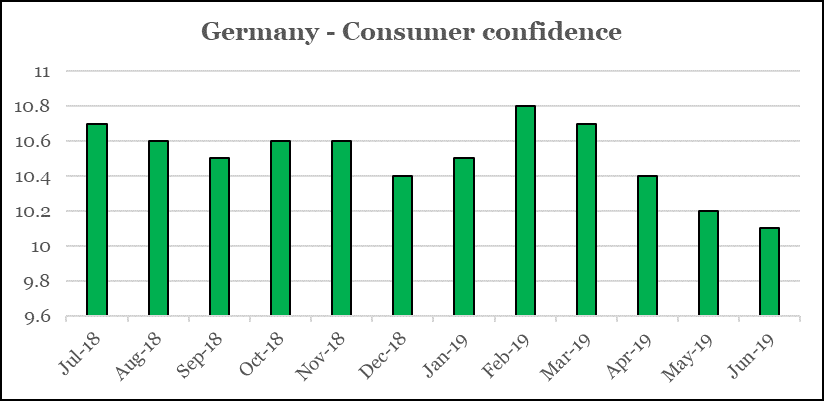
In the United States, the economy also faces some headwind, where for example, the industrial production currently shows a larger decline in the growth rate than expected (graphic two). In my view, it overall confirms that the global GDP growth in the second quarter will not be fantastic.
In no way do I intend to create an early summer depression, and there is no reason for a bad mood anyway. The core rational reason behind that view is that one cannot change the financial markets anyway, as it is what it is. The consequence is that it constantly requires investors to move around in the market, as they can’t move the market, which in itself requires some agility.
But it is not enough just to be agile, as there is another complexity that arises. It happens when one considers the prospects for the financial markets for the rest of the year- the complex issue is always what all the other investors, market participants etc. expect?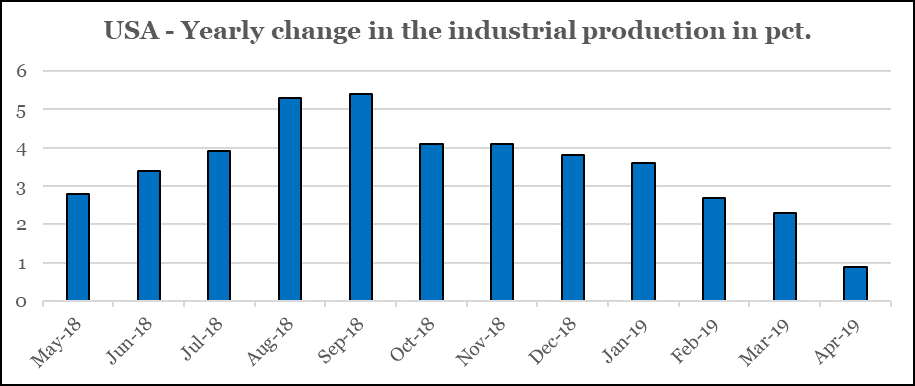
When one works with a so-called “conviction model” in the financial market daily routine, it typically contains a number of factors that are weighted with greater or lesser importance. Typically, one has an evaluation of the factors, and additionally, how much weight do the factors have in the conviction model, and also how strong one’s belief is in the assessment is– certainly the strength of one’s own belief swings, believe me.
However, all these components are still within the limit of clarity, but it’s already getting obvious how disciplined the work begins to be, rather than just a quick call about whether the US dollar should go up or down.
The second part of the “conviction model” is basically a copy of the first part, but one additional element is particular exciting. The second part also includes one’s own assessment of what the financial market in general expects about the same elements in the conviction model, including how important the individual components are and how convinced the other market participants are- to cut it short, what do others in the market expect?
The prior long and pretty dry paragraph might at least contain some comfort. In the first section of this article, I highlighted a couple of examples from the global economy that give reason for a slight worry and is a heads-up for what awaits investors in the coming quarters. But if one just focuses on the second half of the conviction model and asks the open question “what do the others in the market expect about this development?”
To this, in my conviction model I say that there are hardly many in the financial markets who trust in a strong global GDP growth during the current second quarter. The key take is that if everyone else in the financial markets have already included weak macroeconomic expectations in their respective conviction models, then sluggish economic data does not necessarily trigger a major negative reaction among investors.
After the strong and bullish stock market during the first quarter, one could argue that anything can trigger a big sell-off in the market. Though I advocate it requires the global stock market to be in a bubble, which I do not see strong indications of.
But less can make life uncomfortable for investors, like a dry summertime with an ongoing flow of halfway weak macroeconomic numbers. This situation is definitely an option, and I see this as most likely. Therefore, it is quite important to assess how many in the market already have the same expectation. As mentioned earlier, it is my belief that many are prepared for less exciting key figures. All in all, it contributes to a slightly negative mood, but not overwhelming so. I still argue that the stock market has some robustness.
What I pay particular attention to is whether the negative developments are intensified. Both graphic one and two represent developments that are very important, so the dive shouldn’t continue for too long. But one must keep in mind that many economists since some time, have argued for a recession in the United States. From that perspective, even half-sluggish numbers are not too bad, but a low GDP-growth will force various changes in many countries.
If low growth takes its grid on an increasing number of countries, then I expect several governments to push for increased domestic growth. But not all economies have the fiscal manoeuvre room to realise the growth dream. When investors study the macroeconomic indicators over the summer, investors will look for the countries that can support domestic growth- regardless of whether investors sold in May or remained invested, I still expect the investment flows to leave Europe towards growth.