


Teaser: The global economic crisis caused by the Covid-19 will bring huge changes, though many investors may not have priced in all the new directions yet.
A majority of the revised long-term views on the financial markets that I have been presented with over the past month incorporate and compensate for the expected economic effects of the Covid-19 crisis, but very roughly said, most of the strategic forecasts mainly prolong the current situation mixed with the effects of UN Paris agreement about the climate and a few additional themes. There are many isolated ideas, but it seems like most large players trust in a world that will continue as we know it, though with some corrections.
Looking five years ahead, the expectations on returns from the various asset classes shouldn’t scare investors either. Given the massive liquidity surplus in the financial system, the return expectations to any asset class is subdued, but not alarmingly low, if one trusts the forecasts.
Mature market equities are expected to return 4 to 6 pct. and up to 8 pct. in the emerging markets. High-yield corporate debt will yield 3 pct. and emerging market bonds up to 4 pct. based on the forecasts I have been presented with, where all forecasts are for the coming 5 years.
To be a bit provocative, I allow myself the view that when looking into this decade, then these straightforward expectations look nice, though the true outcome will be very different.
Linked to the crisis, I still expect that loads of small SME firms will go bankrupt in many countries in the coming six months. This will limit the steepness of the global economic recovery and the GDP growth rates, though not necessarily hurt the stock markets, because many of the large companies are doing fine and private consumption will probably remain robust.
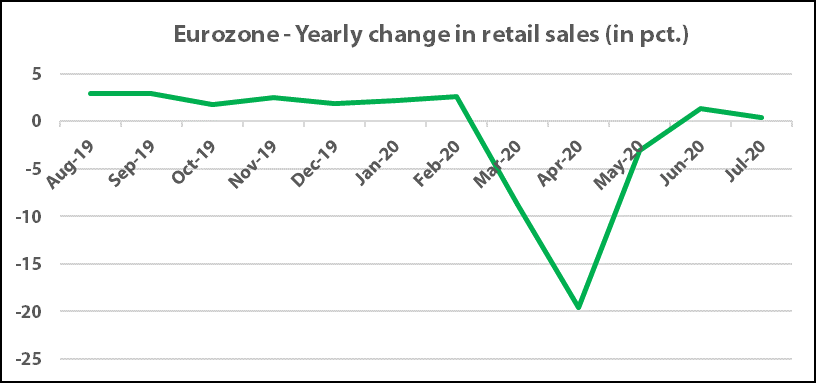
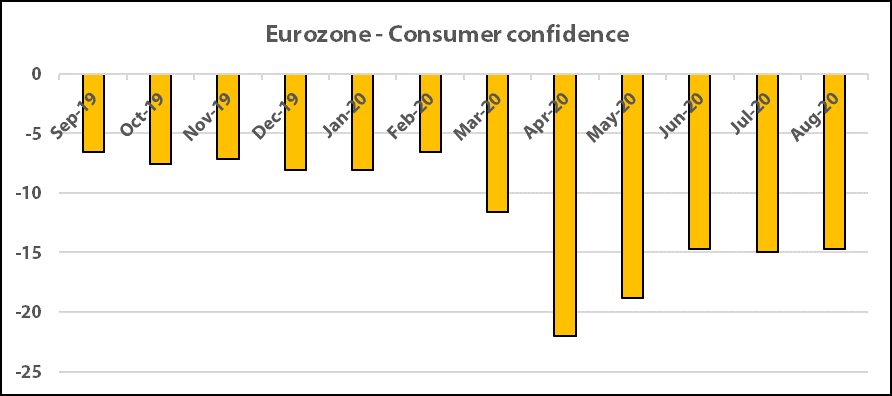
Highly likely, the Covid-19 crisis will intensify trends that were already emerging before the crisis. This means that the low growth situation in the Eurozone will revert after the large rescue package is paid out. During the whole decade, I expect this to create an ongoing capital movement from Europe towards Asia. Therefore, I pay extra attention to how the mood among European consumers develops. As the two graphics show, the dive when the Covid-19 crisis was at its peak is not surprising, but the current development needs to show further progress to strengthen the optimism for the coming year. The conclusion right now is that my expectations remain unchanged, that the Eurozone loses the growth race against other economic zones.
If the assumption of declining earnings among European listed companies materialises, I expect that an even larger share of investors will search towards non-listed investments.
Some theme trends will also intensify, like focus on the Paris Agreement concerning the climate, changes in the energy consumption, and less demand for oil, but entire businesses will also change heavily. This applies for example, to the banking sector, where a myriad of fintech companies will try to cannibalize the large endangered financial dinosaurs in Europe- the European universal banks.
My expectations described in the prior paragraph are some of my early stage forecasts that have been derived from a changed world, combined with some of the mega-trends that I trust will continue. For me, the current crisis confirms that minimum of every 10 years, the world will be hit by a major crisis, which also emerges as a global economic crisis. How the next crisis will look like is completely impossible to guess, but it will come.
Until then, maybe at the end of this decade, my primary scenario is that the global economy and many individual economies will be in a sort of transition, due to changes in several directions.
As a couple of examples, the first one is electric cars and self-driving cars. Electric cars are slowly gaining ground and are developing, but in many aspects, they are still not a true substitute for conventional cars. Right now, a part of the competition is related to the battery and the reach for the car, though I expect a hydrogen driven engine to be the future, so the electrical car might serve more as a transition solution. Self-driving cars are far from finally ready to drive safely into traffic, though one day, they will be ready, and the true jump is from a conventional car to a self-driving car with a hydrogen engine– that’s truly a move forward, though it might take another 10 years.
Another example is the airline industry, that very much remains in a complete stand-still, and this challenging period will be long. All carriers are shrinking their capacity, skipping the larges planes, etc. Soon, the green taxation thinking will resume and it’s very likely that governments will find it reasonable to tax the remaining passengers with a green tax, now that the industry is changing anyway. I argue that it will take years before the highs of the airline industry is reached again.
There are many examples of these kinds of transitions that the Covid-19 crisis will cause, intensify, or speed up– all these possible directions represent a challenge, but the transformations will come, and I instead choose to regard the developments as new opportunities opening up for investors, as the financial markets always does.