


Teaser: In the stock markets the general optimism is obvious, but smaller companies in many countries are kept afloat by access to extra liquidity- though earnings remain scarce.
Every day I get questions like how much the stock market can continue to rise, or whether it has already gone up too much? To be completely honest, these are also questions that I ask myself each morning.
Interestingly enough, there are a few good reasons why the global stock markets have rallied consistently since the bottom was hit approximately 5 months ago. The heavy loads of fresh liquidity from the central banks are pushing money into the stock market, which is well known. The large listed companies that benefit from the crisis weigh heavier than the companies that lose out on the crisis, so the bottom line is a kind of positive net result.
My assessment remains that larger companies have a greater chance of getting through the Covid-19 crisis than smaller companies and it is typically the large companies that are listed. For me, it is still unknown how positive the economic rescue packages around the world will affect the national economies, as well as the individual companies. Almost all national economic aid packages have included some form of liquidity support to small and medium-sized enterprises (the SME segment with up to 250 employees). The problem, of course, is that liquidity support simply risks postponing the pain for the individual companies, where the biggest pain is bankruptcy. Assessing how big the bankruptcy risk for SME companies is around the world is, in my opinion, the current largest unknown in the financial markets in connection with the Covid -19 crisis.
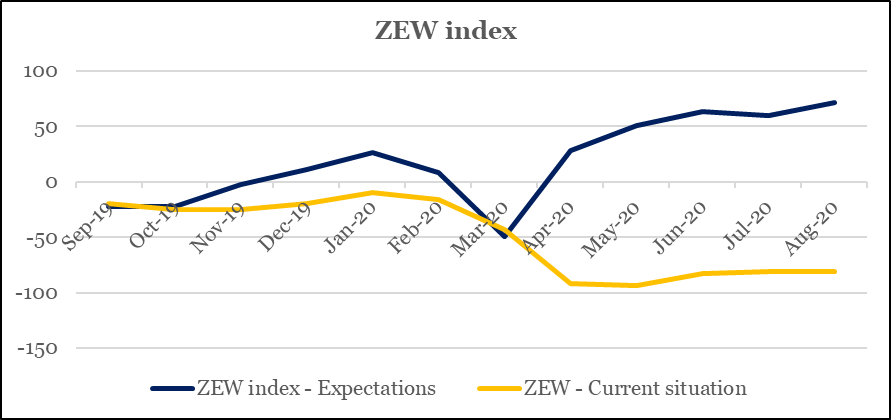
The current optimism among many equity investors is based on the premise that there will be a vaccine ready against Covid-19 by the first quarter of next year. I would argue that the premise includes a fairly widespread vaccination at the time. The optimism is widespread, and the German ZEW indices illustrate it quite well (graphic one). Under fairly normal economic conditions, there will be a correlation between the expectations for the future (the upper line) and the current conditions (the very low line). At the moment, the current conditions continue to hover around the bottom, but expectations about future developments are at their highest in years. The two curves will, at some time, need to approach each other again- I hope the optimists will win the bet. It should be mentioned that this index is the one I am aware of, where the difference between expectations and current conditions have the biggest spread, so it’s not fully representative of either a region, nor globally, but is an indication of how optimism has spread.
Before the Covid-19 crisis, it was my view that private consumption/households represented the most robust factor in global economic growth. In my opinion, consumers in many countries have returned relatively quickly, which is certainly positive. As described earlier, many large companies will probably find it easier to get through the crisis, not that I claim that anybody will have an easy time.
The various national economic growth packages for individual business segments are designed differently, but here, I expect large companies to profit in several ways. For example, the fact that the aid packages equate to economic growth will also benefit large companies.
Looking at the now famous EU economic rescue package, I still believe there will be quite a difference between where the economic support is most needed versus where in reality it will end. Nationally, many governments would certainly like to help the suffering SMEs through the aid package, but the rescue agreement states that the funds must also be used for a number of reform improvements and these tasks/initiatives could might as well be allocated to larger companies. In all countries, the vast majority of SMEs belong to the category that are defined as “micro-enterprises” with up to 9 employees. Typically, companies of this size have no significance in the statistics, and politically, it is difficult to have an impact, which underlines that SMEs can easily feel the headwind.
Economic support packages in many countries include dedicated support to the SME segment, though my view is that the aid packages are often too small. Right now, some countries are providing liquidity assistance, but my assessment is that the SME companies in many countries are facing earnings challenges that will continue into the 4th quarter and into the first quarter of 2021.
I have spoken with several high-ranking managers in credit departments at banks and they share the same concern, namely that in about six months, the real financial problems in the SME segment will surface, because liquidity right now is plentiful, thus, companies are kept afloat. Because it is completely impossible to get up-to-date information about the financial situation among SMEs, it is in my opinion that it is one of the big unknowns that investors are currently facing.
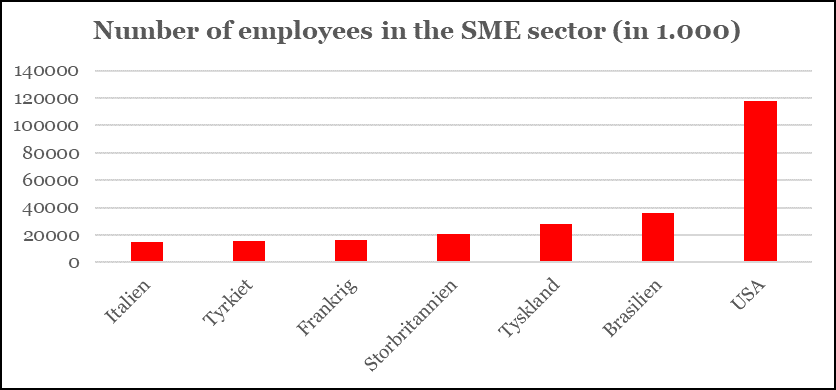
The SME segment represents large numbers which shouldn’t be underestimated, that is underlined by an OECD report from last year, giving an outlook for the SME segment for the entire OECD area. The report is almost 400 pages long and contains a lot of good information, however, a lot of data is from 2015, which is the same challenge concerning analyses from other organizations. Back in 2015, the SME segment employed 118 million people in the United States, in Germany, it was 28 million people (graphic two), which illustrates the total importance the SME sector.
All over the world, the vast majority of SMEs are micro-sized, and no doubt will many of these have already laid-off employees. The wave of bankruptcies has not yet materialized in many countries, but in six months’ time, it will probably start, and it can be huge. Of course, this will affect the banks’ results, though in connection with the expectation that many economies will continue to prosper next year, the problems for a part of the SMEs will pull in the opposite direction- in my opinion, it fits into the picture of an economic recovery, which of course will be positive, but not as steep and fast as the expectations in the ZEW index indicates.