


Teaser: The Covid-19 pandemic is reaching a global high, but many countries are already trying to get back in the game to ensure growth and prosperity, and this is quite exciting.
The hope is that the economies will naturally follow the stock market’s rapid return to the same price levels as prior to when Covid-19 hit the world economy. Though one of several challenges for investors is to figure out if the economies “just” are heading back to the level they were at before the virus went around the world? Nowhere was the economy rosy, but conditions were particularly weak in Europe. A question that investors will be faced with, especially this year, is whether Europe is just fighting to get out of the current economic crisis in order to get back to a “zero growth plus” situation?
As always, we will know the answer afterwards, but my view is that the economic crisis that arose from handling of the Covid-19 virus could very well change many things and directions. By that, I also say that investors will most likely have to re-orient, because the world that we knew when this year started just a few months ago, has changed so much, that the future journey now looks somewhat different.
When not only the stock market, but the entire financial market collapses, as it did in March, it really laments many investors. A basic reason is simply that the market movements are so large and fast, that there is no time for considerations. However, the pleasant return journey, with almost daily positive markets, like during the past 1½ months, also has a negative effect on investors. It almost results in a kind of speed blindness, as the direction is only one way, which is up, and one does not have to challenge oneself or the investment portfolio, as the money simply rolls in again every single day. But if I stick to what I wrote in the previous paragraph, the current hassle-free journey will stop one day, maybe even abruptly. That point is also the latest moment where investors will be forced to make some long-term decisions about how Covid-19 will change the global economic landscape.
It is still at an early stage to interpret the global economic effects after Covid-19, but one development that I consider to be probable is that the trends that were already in place before the virus outbreak hit the world will be intensified.
Investors involved in Emerging Markets investments most probably have the 10 ASEAN (Association of Southeast Asian Nations) countries on the radar screen, as this Far Eastern grouping is a classic growth area. Historically, these countries have been able to recover quickly after various crises, but nothing is as it usually is, and it is a fair consideration how quickly the recovery will happen this time.
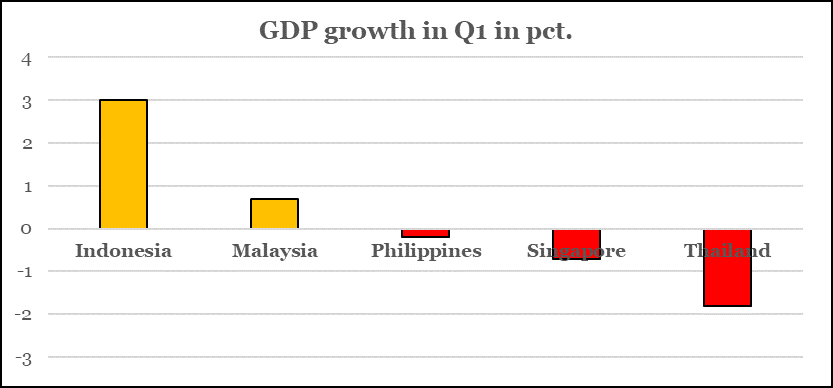
As graphic one shows, both Indonesia and Malaysia came through the first quarter with fewer bumps than most, but the economic growth in both countries were lower than expected. In addition, it is worth noting that several Asian countries were affected relatively early, because much travel activity vanished quickly after the first outbreaks in China. Thailand’s hotel and restaurant business declined by 24 pct. in the first quarter, and the country’s government has not yet opened-up for the travel industry.
For the Philippines, the negative growth came from different sectors like construction, but China was also shut down, affecting many Filipino subcontractors to Chinese companies. The Philippines is also an example of how the Covid-19 crisis will be prolonged this time, as China’s economy is still not up and running on the same level as before the crisis, and the Philippines is still in partial lockdown.
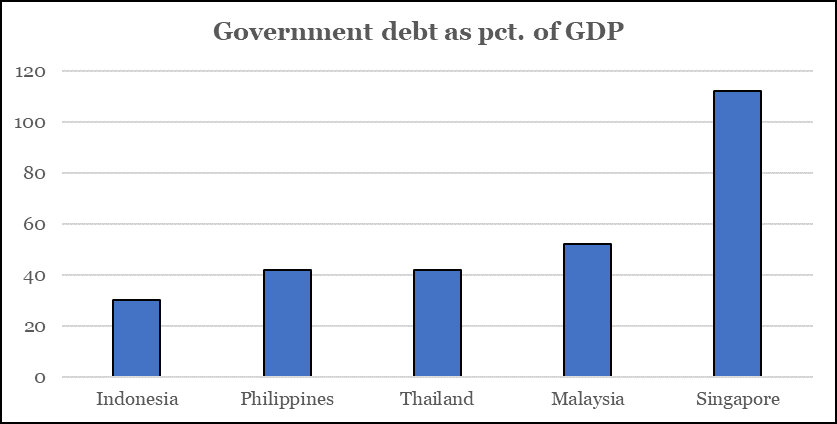
It seems that Europe, for once, is getting out of trouble faster than, say, the ASEAN countries. But then the question re-emerges- is it simply a return to economic growth on par with the pre-Covid-19 crisis? Right now, the growth packages are pumping out into the European economies, but as graphic two shows, most large ASEAN countries have better fiscal manoeuvre room to undertake economic growth packages compared to many European countries.
My current main scenario is that the ASEAN countries will return to high economic growth rates, but I pay attention to whether the respective governments are able to implement sensible growth packages. In the long term, I look at how the tourism industry continues to evolve, but also whether manufacturing is relocated from China to the ASEAN countries. I consider that very likely, which could be the production of semiconductors, as an example.
Whether the Covid-19 crisis intensifies these developments is an open question, but overall, I argue that the gap between the GDP growth in the ASEAN countries and the Eurozone will widen so much, that the ASEAN countries suddenly become visible in the global economic landscape. Right now, the ASEAN countries represent 3.3 pct. of the global GDP, whereas the Eurozone counts for 16 pct. At the end of this decade, my current view is that this ratio will move to 5 pct. to the ASEAN group, and 13 pct. to the Eurozone. It may not seem like a lot, but if one also includes the Chinese economy with an expected size of approximately 22 pct. of the world’s total GDP in 2030, then it means that solely the Far East (excluding Japan) represents more than a quarter of the world’s GDP in 10 years. At that time, the US will probably still account for slightly over 20 pct. of global GDP, which means that the Far East and the United States embrace more than half of the world’s GDP in just 10 years. Yes, my assessment is that the Covid-19 crisis is intensifying this development, and it will have a huge impact for European companies and investors.