



Teaser: The Covid-19 crisis is still far from over, although stock markets have long begun to look ahead, but it’s also time to look at the economic megatrends amid the macroeconomic chaos.
The global economy is now entering the phase dominated by what I call “chaos numbers”. We all know that the harsh lockdowns around the world have generated an economic meltdown in many countries. This is no surprise, but now, the economic data starts to describe how wild the situation is in some countries, and even in very important economies. I refer to a part of the macro economic data as “chaos numbers” because they partially are extreme, are important, and in the case when originating from important economies.
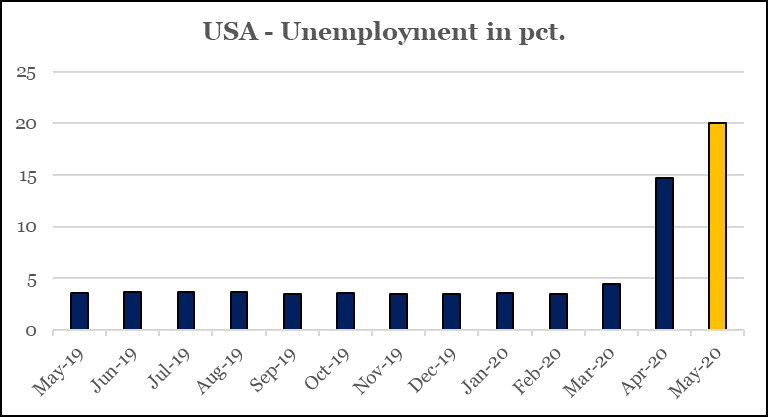
The prime example is the labour market data from the USA. The April unemployment rate was 14.7 pct. (graphic one), a historical high- in the world largest economy. On the 5th June, the rate will reach an even wilder high at around 20 pct., but so far, the financial markets are very relaxed. The world economy will improve after this Covid-19 downturn and many countries will move forward as countries begin to open-up again. But how many of the millions of unemployed in the US will go straight back to their jobs? Many will, but not all of the newly unemployed people can get their jobs back again, and the reality is that nobody knows how many will end up as jobless. USA is in the biggest economy in the world and nobody really knows where its labour market is heading, which is why I call this piece of data a “chaos number”.
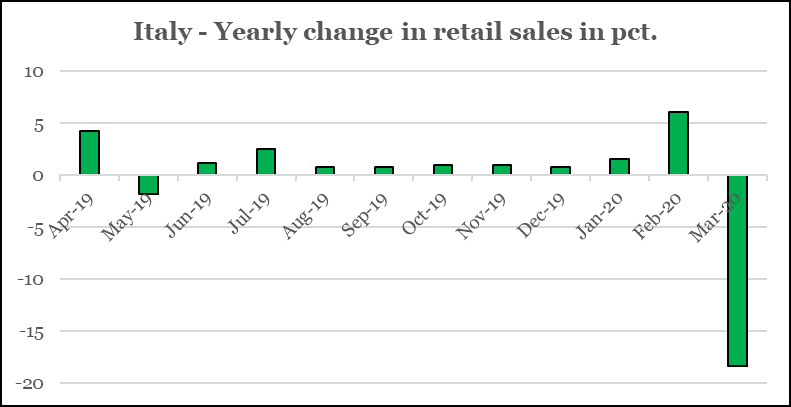
Italy was not just a hotspot for the Covid-19 outbreak in Europe, but also a long-lasting hotspot for economic trouble in the Eurozone. This increases the “chaos factor” as the total lockdown of the country caused an 18.4 pct. yearly drop in retail sales in March (graphic two), followed by another expected nosedive to minus 25 pct. in April. It might not come as a surprise, but the consumers still need to get back in the shops again. Another “non-surprise” is how the Italian service sector is suffering. The latest reading of the service sector PMI for April was at 10.8– another chaotic number. Index 50 is neutral, where a move of plus/minus five index points is almost extreme, so this shows that Italy does not just need to recover, no, it needs to recover a lot.
The above examples, I argue, indicate that the risk for macroeconomic chaos is bigger than what the financial markets currently price in. In the coming period, a part of the economic risk will be counterbalanced by financial aids and public stimulus packages. Though there is also a need to look further out, as far from everyone can just step out of a financial or macroeconomic risk. Many large investors must be invested in something, boards must strategically deal with their companies’ markets, etc. But the current “chaos numbers” also causes a partial chaos in the crystal ball for mega trends, and the clarity is not as fine as normal, partly because the mega trends are also changing.
For years, I have argued that inflation would stay low due to ample supply of energy, workforce, and production capacity, though during 2019, I saw a slight risk for an increasing inflation pressure. This risk is surely gone, and inflation will remain low for years to come. It might sound sweet in many Emerging Market countries, but there is a high probability that the low inflation will be caused by lower demand and lower housing prices, which on the contrary, is less rosy.
An example of a megatrend that is about to invert is the public sector debt mountain. I had expected that more Western countries would let the government debt explode by the end of the 2020’s to boost the growth, but it is already happening now, and a part of the refinancing will be carried by the national central banks. This weakens the fiscal situation for many countries, and they are suddenly less crisis-resilient, which is a big sudden change.
Among megatrends, I expect the Covid-19-generated economic crisis will cause some trends to become more extreme. Since a number of years, the work with mega trends in my firm has included the work with macroeconomic A, B and C countries, where A-countries are the attractive investment destinations for various reasons. C-countries should be avoided, but B + is still a good opportunity, where B- has the risk of becoming a C-country. The cleavage among these groups becomes more pronounced with even more countries dumping from B- and down into the C-group. For a C-country, economic life really risks to become a trial. The Covid-19 crisis has clearly shown the value of being prepared, including being financially fit, as other existing mega trends are already making life more difficult for C-countries, like a country almost can’t devalue itself out of a crisis anymore. A main reason is that the global trade of goods is under pressure, while the turnover of digital services is rising, and further will domestic growth gain more focus in many economies.
A further consequence of this scenario is that large global companies will grow even more in importance, especially the digital giants. At the same time, they will be examples of companies growing larger than C-countries, and they will much easier be able to attract investments and investors- I have no doubt that an effect of the Covid-19 crisis is that this development in the global economic landscape is amplified.