



Teaser: Some of the best German economists have developed a new economic index that acts as an early economic indicator, and it is made with inspiration from the US central bank, which is quite exciting.
On Monday, the 18th May, the German central bank, Bundesbank, presented a new index that may become the new darling of the financial markets. The first signal provided by WAI (Weekly Activity Index) is encouraging and could be another reason to become acquainted with WAI during these Covid-19 times.
WAI includes seven components that can be measured 24 hours a day, all-year-round. In addition, the data used as input is largely available in real time, which is one of the very exciting elements of WAI.
The basic requirement to the seven components is that they represent a strong importance for economic activity. The components must describe different activities in the economy to avoid a double accounting effect in the index.
The first component, the central bank calls “realized electricity consumption”, where corrections have been made for the transport of electricity and for the electricity companies’ own electric consumption. The second component is the toll that truck companies pay for having their trucks driving on the highways. The electricity consumption and toll are the two indicators used in the WAI model to predict changes in production. The toll is also the sole indicator for the developments in trading/commerce. In order to predict the development of the labour market, the central bank includes data from Google by measuring the use of two keywords. One word is simply “unemployment” and the other is “shortened workdays”, which corporations can introduce during an economic crisis.

To describe the global economic activity, the model just uses one single piece of data, namely the total number of flights worldwide, including both passenger and cargo flights. Again, it is a very straightforward approach to data today, as WAI retrieves flight data from the same source that many others also visit, the site flightradar24.com.
Over the past decade, new data has of course emerged, which WAI also uses, in this case to measure on the penultimate component, mobility. There are now so many stationary measurement stations for air and particulate pollution in German cities that the information also makes it possible to measure changes in mobility quite accurately. Again, using data that is publicly available and is collected from the European Environment Agency.
The seventh component might confuse readers in China and the Nordic countries because it is something as basic as the change in the circulating amount of banknotes, or more precisely, how much cash has been withdrawn in banks and ATM machines in Germany within a week. China and the Nordics are among the countries in the world with the highest online shopping frequency and the use of electronic payments is outspoken in general. Germany is far behind in this development and therefore, cash payments continue to be widespread in Germany. And it is here that the central bank finally plays the ace where they make use of the central bank’s insider knowledge, in this case, about the daily cash activity in the German banking system.
A first quick thought is that this data fluctuates tremendously depending on the season, which is correct. But WAI is designed to make a so-called seasonal correction for every single row of data that comes into the model. This work contains some complexity, but primarily requires a credible data history. From here, one can consider whether the air pollution has sufficient historical data, which the Bundesbank logically considers to be the case. Alternatively, it could be that air pollution is the best indicator of mobility and I think it is an exciting piece of data to use in this context.
The next step in the model is to generate a moving 12-week average out of the weekly WAI indications, therefore, as early as the end of each quarter, there is a prediction on the GDP growth for the finalised quarter. And after so many fine words, then comes the natural question- are WAI’s predictions useful?
Especially important is whether WAI measures on the right components, which Bundesbank also mentions, though I regard the whole work that surrounds the model as well-founded and of high quality. But other than that, I believe that it is too early to tell, as the financial market has only just been introduced to WAI a few days ago. However, my expectation is that many people in the financial market will pay attention to WAI, and that alone makes the index interesting, at minimum, until it shows how accurate the predictions are. The fact that the index is so recently released also means that I have not been able to retrieve data to illustrate the index graphically, but the index curve nicely follows the development in the GDP growth shown in graphic one.
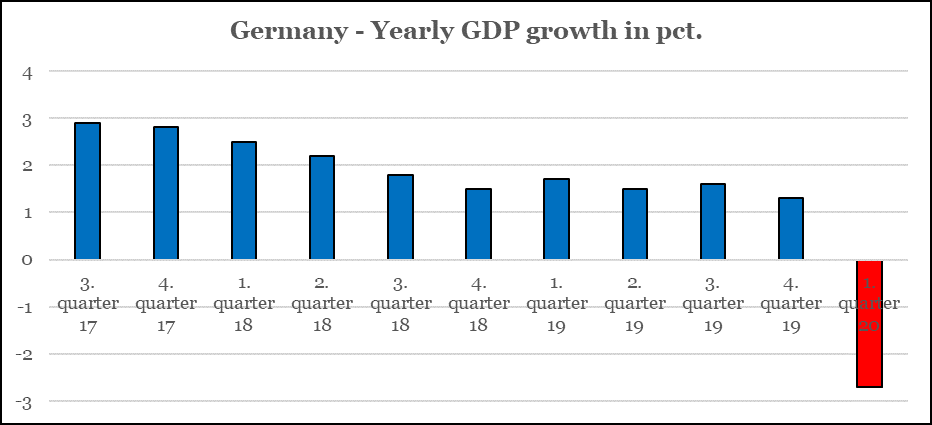
The first index number that has been published is the figure for 12th May, which showed minus 4.6. The index has been somewhat further down during April, according to the Bundesbank, which is why they assesses the current trend to be on the positive side.
But it is a rough world that WAI encounters from day one and in my own assessment of the German economy, even fewer components are currently being included. They are not as early predictors as WAI’s data, but I look at how consumers are doing, which includes consumer confidence as well as the actual retail sales, where my expectation is a cautious behaviour among consumers. In addition, I continue to give the car production and the whole automotive sector in Germany a special weight when assessing the outlook. In April, the total number of newly registered passenger cars across the EU dropped 76 pct. compared to a year earlier (graphic two).
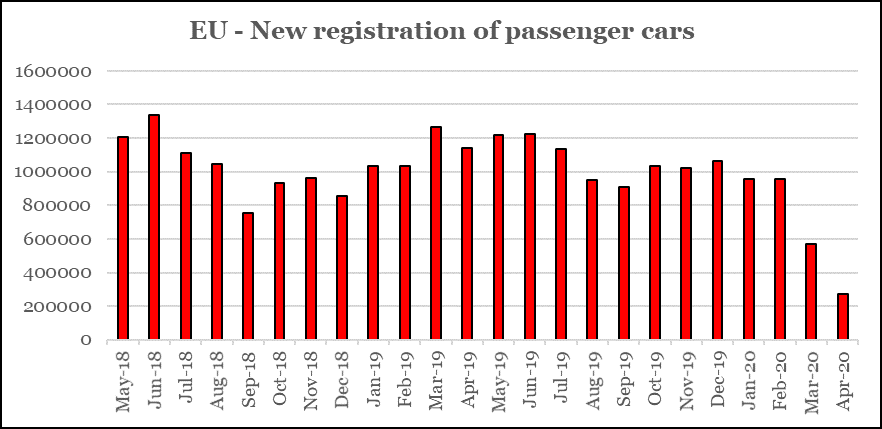
This is due to the Covid-19 crisis, but the whole automotive sector has been under severe pressure for years now and the recent drop just highlights the huge challenges that the German automotive sector continues to face. A few weeks ago, the German car industry tried to find some support from the German government, but there was no help to fetch. One should not underestimate how important the automotive sector is to the German economy, and it might be a risk that WAI will not capture this quite precisely in its data input.