


Teaser: The fintech sector has been developing for some years now, but it is quickly approaching a time where fintech must prove that it really puts the established financial sector under pressure.
In 1971, the company Charles Schwab & Co. (today The Charles Schwab Corporation) started as a stockbroker in San Francisco. The idea was to utilise new technology to offer stock trading for retail clients at a discounted price. Charles Schwab & Co. wanted to “disrupt” the market, which it wasn’t called back then. The vision of optimising via the use of new technology long before important developments like the internet and Microsoft Windows is quite fascinating.
Charles Schwab & Co. really did disrupt stockbroking for private investors. It is in the company’s DNA to develop this way, which has not been entirely meaningless, as the market value of the company is now USD 55 Billion and employs almost 20,000 people.
Charles Schwab and Co. stood for significant changes in the price structure of stockbroking and thereby was a threat to the Wall Street earnings machine. It is quite simple to draw a parallel between that story and today’s fintech companies, which of course, is also the intention.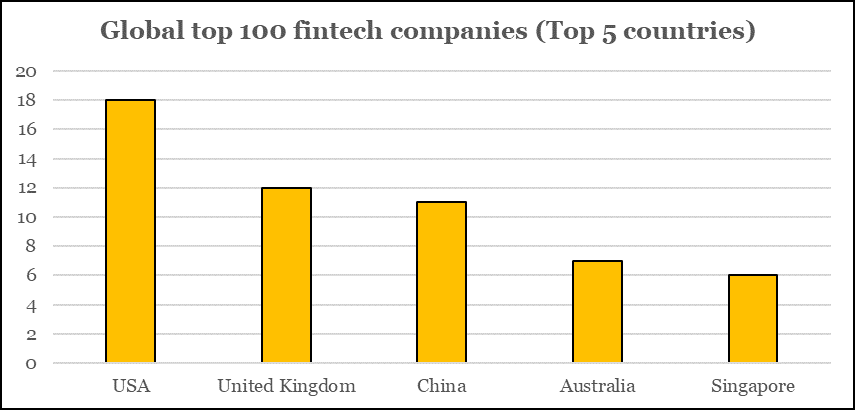
Allow me to jump to China for a moment. If one looks at the start-up culture in China, many young companies are quickly linked to large established companies in their same sector, which not only applies to, for example, the tech sector. This way, the established companies get access to new and different ideas, while the interesting start-up companies on the other hand, have easier access to capital.
But very distinctly, I do not see that symbiosis among European banks and fintech companies. Therefore, the banks are sensitive to disruption from fintech companies, and the sensitivity is even more outspoken because earnings among European banks is as low as it is.
As the banking sector simultaneously complains about pressure on earnings due to the zero interest rates in Europe, my assessment is that the prospects are weak for the European banking sector in the coming decade.
It has an impact for investors when considering the stock portfolio, though it also has a broader macroeconomic impact, as a weak financial sector can hamper the economic growth that Europe so desires.
It is my most likely scenario that the development will happen as described, and quite quickly for that matter.
To find inspiration about where the fintech world is heading, I will, as always, point to the annual Fintech100 report from H2 Venture and KPMG. In previous years, it has been during June / July that fintech companies could qualify to come on the famous list in the yearly report, so it’s interesting to see who qualifies this year.
The organisations behind the report designate the companies that they consider to be the 50 largest fintech companies in the world. In addition, another 50 expanding or emerging companies are selected, which in total makes the top 100 list.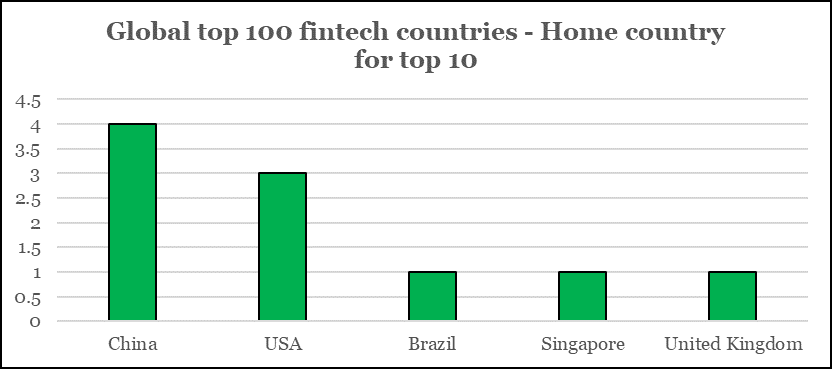
The two graphics illustrate the battle on global fintech leadership between the United States and China. China is in the lead, but in my opinion, it belongs to the story that the Chinese companies’ position in the global top 10 also is a function of the country’s size.
When looking for threats to the established banking sector, the trend is that there will be more new fintech players within asset management, which is traditionally a good income source for the banks. But very interestingly, the number of “neo banks” also grows where digitisation plays a greater role combined with processes that are carried out in a simpler or smarter way.
On the top 10 list of the largest fintech companies, one finds the American company Robinhood. In 2017, the company was ranked as number 50, though it jumped to enter the top 10 list last year. The company offers an app where retail investors can trade US stocks and ETFs (Exchange Traded Funds) without paying commission. The product that is offered will surely be further developed, but it gives an idea about the next disruption in the American stockbroking business.
Of course, Robinhood has an appetite for more than just the market in the United States. But the development in the United States alone is very exciting to follow. The stockbroking establishment now includes companies like The Charles Schwab Corporation, and it will be exciting to follow how the financial establishment deals with the new generation of fintech disruption.
One can very easily let fintech sound like the solution to everything, and at the same time, the end of the current classical banks – but it is not as simple as that. Fintech is many things, where some make current processes cheaper and/or more accessible for small firms. Crowd funding is a good example of an early fintech development, which simply made it easier for smaller companies to find investors who would just want to invest for small amounts.
It’s a simple principle, but there was an outright run on the platforms. Thus, it is no longer so easy to find funding via this channel, because loads of start-ups are now trying their luck this way. The consequence is that a small company now has to get ready via the social medias, work hard with its presentations, documentation etc.
Therefore, a large number of small companies still consider the classic source of funding – the bank. A crucial element for companies looking for funding is to generate a contact with the funding sources, which a platform does not necessarily offer, even though it offers smart and efficient transaction processes.
My best bet is that there will still be a need for banks, but the attractive ones are those who find out how to navigate in a completely different financial ecosystem that emerges during the coming years.