

Teaser: Italy made headlines ahead of the EU election due to the League Party, but even after the election, the headlines will continue – though due to the economy.
In Italy the League Party, as expected, became the largest party in the EU election during the weekend. My main scenario therefore remains that Italy will attract further attention from international investors after the election to the European Parliament. The main reason is that the election outcome has cemented Italy’s very critical stand towards EU and the Eurozone, both in domestic politics and in the EU Parliament.
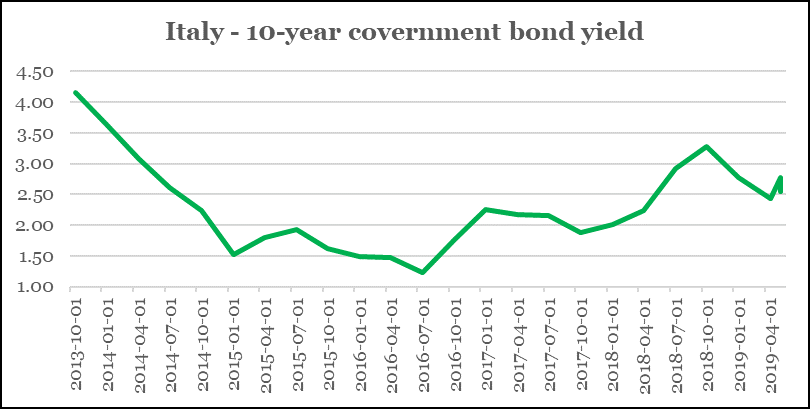
The reactions in the bond markets is a good indication of how close investors are following the development in Italy. The yield for German 10-year government bonds during May traded at its lowest level since 2016. This means that the interest rate is negative again– even the Greek government bond yield traded lower.
But as graphic one shows then investors are somewhat more concerned about Italy. Interest rates tend to rise as soon as there is a disagreement between the Italian government and the European Commission. The currently rising yield came after the European Commission’s new calculations, showing that Italy’s budget deficit will grow to 3.5 pct. of GDP next year. It is well above the accepted limit of 3 pct., but also discloses a budget that only increases the deficit without any significant reforms, and such a development makes investors nervous. I expect that the very hard rhetoric, from the League party even will be intensified ahead of the budget negotiations that are coming during the second half of 2019.
At the weekend’s election, the two major factions in the European Parliament, EPP and S&D, lost their long-standing combined majority. I do not think that will affect the euro nor the financial markets in general. However, it may be a noise factor that the election created internal problems in the German government, and thus the German position is once again uncertain. This may push the euro slightly lower, but it is the situation in Italy that recall my biggest interest.
For a long time, I have had the opinion that the Italian economy will continue to suffer, and one day, Italy will end-up with a junk bond status. To cut it very simply, it would be a disaster if the Eurozone’s third largest economy should end-up like that. My focus is on whether the speed of this development is intensified during these times when Matteo Salvini’s League Party is so powerful and the economic growth in Italy and in the Eurozone is under pressure.
Although the sunshine must of course not be ignored, and it was gratifying that Italy’s GDP growth in the first quarter was plus 0.2 pct. This was after two quarters of negative growth, which means that Italy escaped a so-called technical recession. The expectations to the growth in this second quarter that I explore among economists seems extremely modest, i.e. Italy is heading back towards zero growth in this quarter.
When assessing the Italian economy, one should not forget the report that the Italian central bank published last year. It very clearly describes the damaging consequences that rising interest rates have for the Italian economy and the financial sector.
My own assessment, also partly based on the central bank’s calculations, shows that just the turmoil Matteo Salvini created in the Italian bond market last year did cost Italy more than the government’s extraordinary fiscal spending pumped into the economy.
That Italy’s financial sector is under pressure is well-known and is currently exposed by a necessary rescue operation for Banca Carige. It is the fourth major rescue operation of Italian banks within a few years. Until recently, the US investment fund BlackRock, was very interested in taking over the bank, though the Americans left the deal. The official explanation was, of course, that BlackRock could not make the investment profitable. Some rumours said that Italy’s populist government and the prospect of long-term economic zero growth in Italy were the real causes. I consider this as extremely worrying as it confirms my own assessment, and it is absolutely possible that other investors have the same thinking…
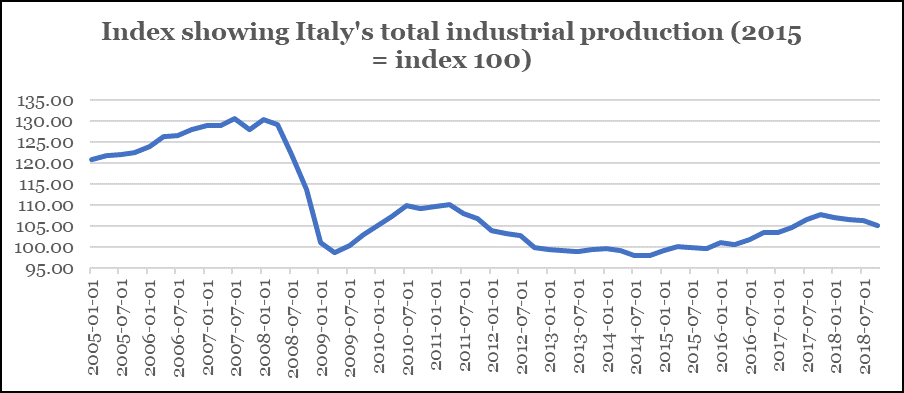
Even more crucial is whether the credit rating agencies’ sceptical stand on Italy could grow again. As mentioned, it is my main scenario that Italy is heading in that direction. Graphic two, as an example, illustrates how the country’s economy has never recovered after the global financial crisis. As described earlier, the financial sector is under pressure, but for example, is the industrial sector also at a standstill. Graphic two shows the total industrial production in Italy expressed as an index. Of course, the industrial production fell during the financial crisis 10 years ago, but many countries have recovered and returned to the same level of growth as before the financial crisis, but Italy is still caught in the swamp.
My expectation is that the hard rhetoric of Matteo Salvini will simply attract more attention to Italy’s situation, and therefore, the risk once more rises for further nervousness in the financial market.
The rising budget deficit to 3.5 pct. by 2020 is one of the important developments that I give extra attention to. But of course, also how determined the government in Rome is about introducing a minimum citizen pay and to change back the pension rules.
The Italian Government is working on proposals for VAT and tax increases, yet they are still unclear, this includes when the tax hikes should enter into force.
At last, there is the reaction from the financial market itself. The risk is now that Italy is moving faster into the negative economic spiral where poorer prospects may well lead to higher interest rates- and here, the country’s own central bank, has made it’s well-written report that explains how the higher interest rates burden Italy’s economy.