


Teaser: China’s GDP growth for the first quarter surprised positively with several encouraging developments, though with some risks, but in the long-term, challenges look different.
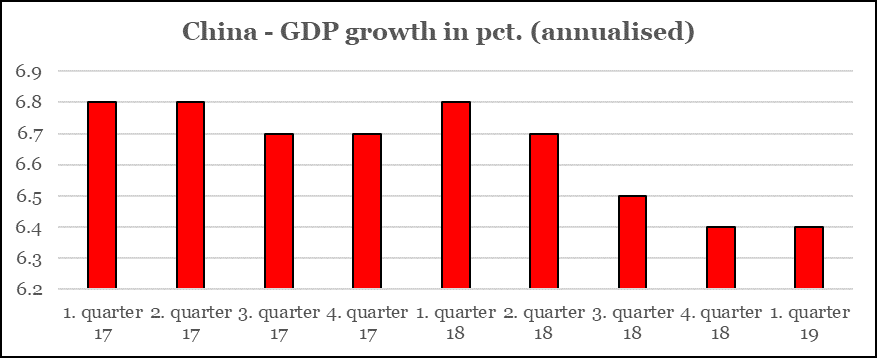
On Wednesday, the 17th April, China announced a surprisingly good GDP growth for this year’s first quarter. In the financial markets, the general expectation was 6.3 pct. growth on annualised basis, but as graphic one shows, the GDP growth landed at 6.4 pct. There are several interesting and positive elements if one dives into the details of the first quarter’s growth. March represented a particularly large increase in the industrial production, which is the sector that has also globally suffered for more than half a year.
Moreover, there is no doubt that Chinese consumers also gave out substantially more money in March. It is of course, beneficial for the GDP growth, but I am quite excited about whether this growth can continue over the coming months, or perhaps even rest of the year. Not only for the sake of the GDP growth itself, but also as a positive consumption response to the tax cuts for the middle class that the government introduced last year. If China’s government has succeeded in stimulating private consumption via income tax policy, I consider it as very positive. This path is healthier, instead of the classic Chinese stimulus with a direct financial support to the direction that the government wants to promote.
Graphic two, however, shows one of the growing risks in China’s economy, despite it being supportive to last quarter’s growth- namely, the continuous rise in housing prices. It is partly a global phenomenon, and still fuelled by the cheap liquidity flowing out of the central banks. Ample liquidity is also one explanation in China, but the situation unfolds into two problems. One problem is, like in many other countries, is that higher housing prices could be a burden for first time buyers.
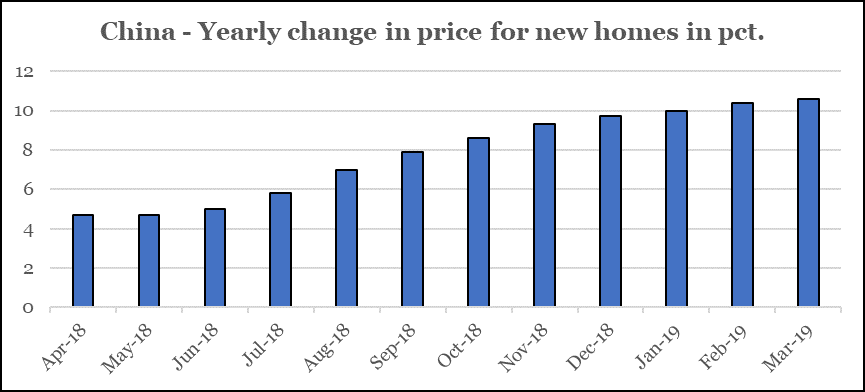
A further challenge is also that the capital intended for the financing of small and medium-sized enterprises appears to be channelled into property projects instead. This of course, contributes to the speculative development in the real estate market. In my view, it increases the risk of more official actions against this traffic which could hurt the property market.
Concerning the challenge with insufficient financing for the small and medium-sized enterprises, I do not observe a solution from the government, which is a worry.
Despite the upbeat note in the first quarter, it does not give me any reason to change my view that the GDP growth will move to 6 pct. faster than the financial market is expecting. Among other things, I argue that the global economy is still cooling down, though there are also elements in China’s economy that can trigger a lower growth.
The real estate market is a sector where the continued price increases surprise me, and as described, there is a certain risk of government actions against this development. Naturally, an official intervention will affect the construction sector itself, along with the service sector, which in total, gives a broader downside risk for the GDP growth.
This is just one example on how the GDP growth could head towards 6 pct. Without actually leading to a particular concern. Other elements in the economy have a chance to support the GDP growth like the recent increase in private consumption. However, my big picture remains that the unexpected growth opportunities on the upside are limited, but the downside is open towards 6 pct.
The reason why I do not consider lower growth in China as a problem is the attractive long-term outlook. It’s fair to expect that in five years, China’s economy is 30 pct. bigger than it is today. Among the globally dominant economies, no one else can offer such a growth outlook, neither in relative nor absolute terms.
In my opinion, the first quarter GDP growth confirms more than anything else that China is moving in the expected direction. This, I regard as central when considering the opportunities in China, both as an investor and as a company. The domestic growth is clearly gaining in importance each year, meaning, China’s dependence on exports is continuously reduced.
Regardless to which extent China’s 2025 plan will become a reality, and how much of the “One Belt – One Road” project will be realised, I argue that China is on its way to become the world’s largest single market.
This prediction should not surprise, but I regard it as one of the most important topics when talking about China. It doesn’t matter if the growth is slightly higher or lower than expected. What matter is whether the components in the GDP data confirms that China continues the journey towards becoming the biggest single market, like the data did for the last quarter.
China is already an attractive destination for investors and companies, though it’s an extreme challenging area to enter. We all know about the barriers; like the language, culture, competitiveness, etc. But to stay outside the coming biggest single-market in the world might be an even bigger challenge.
Examples on struggles for Western companies are already noticeable, but also very interesting to learn from. Since the middle of last year, a number of Western companies have complained about dropping demand, particularly with firms who have very easily sold their products in China. The desire among Chinese consumers to buy the products may well still be present, but the mood among a part of the consumers changed towards a feeling of not having the money to purchase the products right now. The shift happened with the typical fast behavioural change which has been seen so many times in China.
It is just an example on one of the many characteristics of the world’s up-and-coming largest single-market, namely the incredibly fast shifts that occur suddenly, which is followed by new trends.
As mentioned, I argue that this kind of changes are significantly bigger challenges than the coming decline in the GDP growth, which is on the way, despite the good news from the first quarter.