

Teaser: German Chancellor Merkel’s sudden withdrawal as party leader of CDU can become quite interesting for the financial market, depending on the Hamburg convention in December.
On Monday, the 29th October, a bomb was thrown in German politics. Chancellor Angela Merkel announced that she is stepping down as chairman for her party, CDU. So far, the financial markets have not reacted, as the news does not yet lead to any change in German policies. Officially, Chancellor Merkel shall continue in her position as chancellor for another three years. But this outlook can be quite different after the CDU party’s annual convention in Hamburg on the 7th and 8th December, where the new chairman of the CDU is elected.
For the financial markets, this election can be more important than one believes, and potentially, even more important than when Macron was elected as the new president of France.
Chancellor Merkel’s favourite candidate for the presidency is undoubtedly the party’s current Secretary-General, Annegret Kramp-Karrenbauer, who in my optics, is a clone of Merkel. If Kramp-Karrenbauer is chosen, the current reform weak policy trail will continue and the position within, and relation to the EU, will continue as usual.
But one of the former leading figures in CDU, Friedrich Merz, has joined the race, and now goes for becoming the chairman of the party. The first online polls of decent credibility ranks Merz as by far, the most popular candidate.
The third candidate that is in the ballot to becoming the new party leader is Jens Spahn, who has a profile that is similar to Merz’ focus on economics, business, and traditional conservative issues. Currently, Spahn is health minister in the ruling government, and he has a decent support within the party, though he is clearly the outsider in the race.
A lot can happen within a month, when it’s about winning power in a party, but it seems to be a contest between Ms. Kramp-Karrenbauer and Mr. Merz. Should the ballot be in favour of Kramp-Karrenbauer, then it’s even possible that Chancellor Merkel can continue in her position for a while, as officially announced – this outcome will at the same time be a non-event for the financial markets. Concerning EU, the German government won’t change its position significantly over the next 18 to 24 months.
From an investor and financial markets perspective, the key is to keep an eye on Merz and his popularity. Should he be elected as CDU’s new chairman, then this most likely represents a very big change in German politics, and I therefore argue that it would be more important than when Macron was elected as president in France.
Chancellor Merkel has outmanoeuvred many leading persons within the CDU party under her leadership. One of them is Merz, who is now trying to take over one of Merkel’s top positions. Though nobody in Berlin believes that Merkel can continue as chancellor with Merz as party leader due to the history surrounding Merkel and Merz. The general view is, and it’s also my own main scenario, that Merz will soon take the position as chancellor.
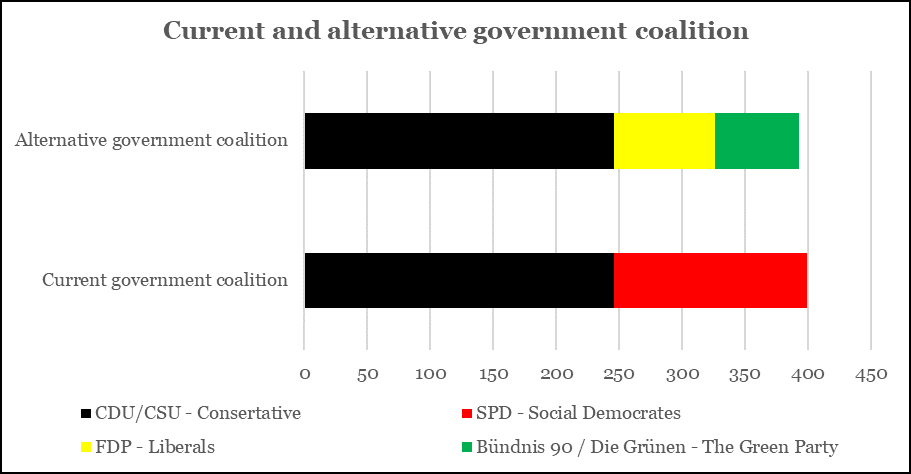
The good question is what happens to the current government consisting of the conservative CDU / CSU cooperation and the Social Democrats? A new election is possible, resulting in a new government consisting of CDU / CSU, though together with the Green party and the liberal FDP. As the graphic shows, this coalition is also possible in the current parliament, and this solution is my main scenario if Merz gets in the driver’s seat. A risk for this scenario could be the Green Party, as they are storming ahead in the opinion polls, they are motivated for a new election.
The consequence if Merz becomes the new party leader is a distinct change in the political direction of the CDU party, and the same will be the case for a new government.
The old image of Merz leans towards his expertise within economics, business, and tax issues. Though if one observes the communication from Merz during the past week, it shows that he is trying to reach out very broadly. Obviously, he needs to prove that he covers the new middle segment of voters that Chancellor Merkel have moved the CDU party towards, though he will also need to capture right-wing voters back. Nonetheless, I still expect Merz to be strongest within the economic topics, thus attracting focus from the financial markets.
I would expect a government with more focus on an economic reform policy in Germany. Concerning the corporate sector, the small- and mid-cap sector would be favoured in a new government, which could even lift the mid-cap stocks compared to large DAX index companies. Though Merz will also be forced to deal with the situation that Germany has a historically low unemployment rate, but a large number of employees remain within the low-salary segment. In case of a political shift, one solution is a higher redistribution of income that will generate a broader GDP growth in the coming years.
Merz is well connected at high level within the EU, and I would expect Merz to be very cooperative with the Eurozone partners. Though what I would look out for, is if there should be a change in the preferred top-post within EU. Chancellor Merkel’s position seems to have been that Germany should go for a political top-post in EU, like the presidency and head of the EU-Commission. With Merz as a new CDU leader, I speculate that Germany might chase the European Central Bank presidency again, instead of heading the EU-Commission.
This will undoubtedly mean that monetary policy is tightened quicker than currently priced in the bond markets, and the southern Eurozone members will find their fiscal life more difficult in the future. The CDU electorate would expect Merz to show a tougher standing on the debt loaded Eurozone members like Italy and Spain – It surely will be very exciting to follow the CDU party election, including the opinion polls, during the coming month.