


Teaser: It has been quiet for a couple of months now in Italy, but scratching the surface discloses that the turmoil returns in one way or the other.
The importance of Italy should not be underestimated, because when United Kingdom leaves the European Union (EU) next year, Italy moves up as a clear number three within the EU measured in size of the economy. The Italian economy is actually more than 40 pct. larger than number four, which will be Spain. For the European economy, it means something if Italy continues to underperform. Politically, it also has a consequence, as the EU is harder to manage if the third largest country simply follows its own track, which can then again unnerve the financial markets.
The Italian economy has underperformed since the global financial crisis about 10 years ago. When 2018 fades out and becomes 2019, Italy’s GDP in nominal terms (measured in U.S. dollars) will still be 10 pct. smaller than it was in 2008, based on the forecasts from The International Monetary Fund (IMF). The continuous attempt at Italian recovery is of poor performance, and it’s natural that it moves voters to new and other parties that promise a better world.
So far, not a lot has happened in Italy since the parliamentary election in March. Many would probably characterise the biggest coalition partner, The Five Star Movement, as a centre-left party, while the other partner, The League, certainly is right-wing. This increases the risk of the government working in two groups, rather than as one team.
The League, headed by Matteo Salvini, has set the agenda by focusing on the migration challenge that Italy faces. This resulted in very good election results for his party in the local elections last month. The outcome confirmed what the opinion polls were indicating, that The League would get the most votes if Italy were to hold a parliamentary election now.
This has built pressure on Luigi Di Maio, the leader of The Five Star Movement. Lately, he tested the waters with one of the many reforms that both parties promised the voters during the election campaign earlier this year.
Within the past week, Di Maio proposed what was announced as a labour market reform. It has been criticised by both labour unions and different businesses, which does not necessarily make the reform bad, and on the contrary, could indicate that is a true reform.
The analysis of the reform that I have seen so far, is that it might add to the cost burden for companies and won’t really bring workers a lot. It mostly looks like an attempt from The Five Star Movement to show some action in a response to The League’s popularity among voters, but far from a real reform. So what is the new Italian government doing?
Nothing. Apart from doing the same as the prior governments – which is drawing on the credit facility at the mutual Eurozone central bank, the European Central Bank (ECB).
After the financial crisis, the ECB also introduced the extreme monetary policy “quantitative easing.” However, the ECB does not conduct the market operations on its own, this is still done by the national central banks within the Eurozone member states. To facilitate the market operations and to get the quantitative easing process rolling, the ECB introduced the “Target 2” system.
This system provides immediate liquidity to member state central banks and commercial banks in very large sums. The transfers are done swiftly, and the funds, for example, can be used to purchase member states’ government bonds. In theory, the aggregated Eurozone central bank balances in the Target 2 system should equalise, which is very likely to occur if all Eurozone members stay together forever.
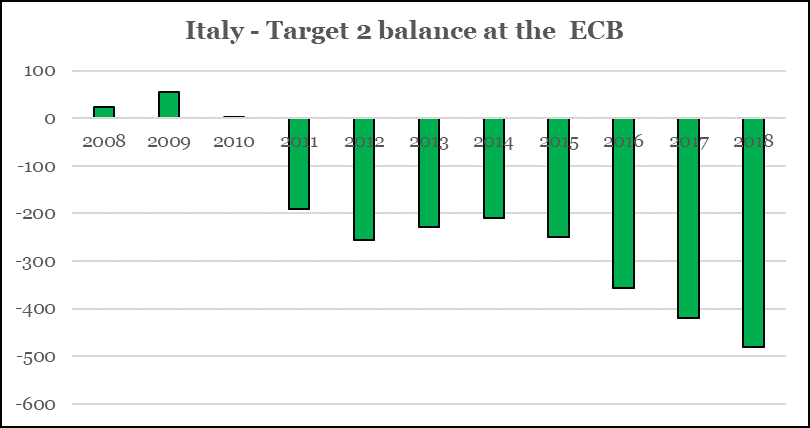
Since the introduction of Target 2, Italy has drawn on the facility, for example, to purchase its own government debt. Last year in June, the balance stood at EUR 430 Billion (USD 500 Billion), but now the Italian debt to the ECB stands at EUR 480 Billion (USD 560 Billion), as graphic one shows. This is equal to around 30 pct. of the total Italian GDP.
As long as the Eurozone stays intact, and the member countries stay together, there is no risk for the ECB. The Eurozone treaty prohibits a member state to leave, but reality can always affect the intention of staying together forever, especially if macroeconomic factors, or the voters, force one country towards another direction.
The risks for the ECB are that the Italian government bonds could lose dramatically in value, the bondholders would be unable to repay the ECB, or the Italian government would be unable to repay its debt.
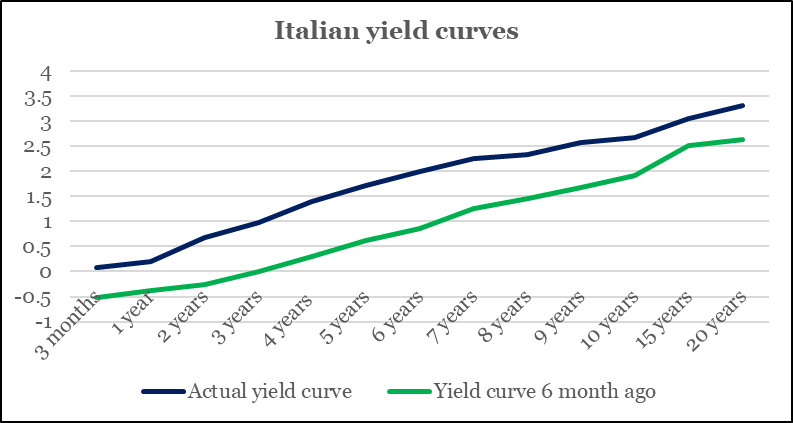
Right now, these are by no means risks, but in a couple of months, the negotiations about the Italian fiscal budget for 2019 will start, and I expect it to be a classical Italian drama. The result of the latest market turbulence is shown in graphic two, where the whole Italian interest curve moved up with a full percentage point just within a few weeks.
The two parties in the new government have promised their voters to roll-back prior reforms that have limited government spending, and introduce new public spending programmes, which would further increase the government debt.
During this process, I am very convinced that it will bring EU Budget Commissioner Günther Oettinger to a boiling point, and I expect him to articulate his view very clearly. I judge it as a realistic risk that the Italian government will repeat their request from this spring about the ECB writing down some of the Italian debt, then the turmoil will hit the financial markets yet again – it is after all EU’s upcoming third largest economy, so the happenings cannot be neglected.